
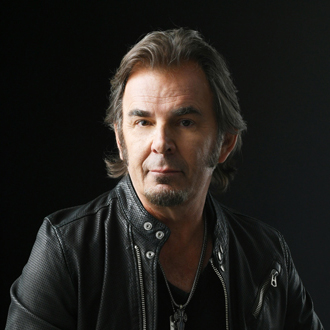
(photo credit: Michael Cairns)
Songwriter & keyboardist Jonathan Cain has been known as a key member of legendary rock band Journey for over three decades. He co-wrote or wrote many of the group’s biggest hits, including “Don’t Stop Believin’,” “Open Arms,” “Who’s Crying Now” and “Faithfully.” Notably, Cain and the Journey members were inducted into the Rock & Roll Hall of Fame last year (2017).
In addition to this work with Journey, Cain has recently released his memoir, Don’t Stop Believin’ (published by Zondervan/Harper Collins Books), which recalls his career with Journey and his life story. He has also released new solo album, The Songs You Leave Behind, a collection of 19 songs that serves as an audio companion to his book.
Cain was born and raised in Chicago, and then he moved to California in the 1970s. He first joined the band The Babys, which featured lead vocalist John Waite. He then accepted an offer to join Journey in 1980, becoming their keyboard player and songwriting contributor. Following seven years of success with Journey, Cain joined the band Bad English in 1987 after Journey had broken up at that time. Then in 1996, Cain reunited with Journey, and he has been touring and recording with them ever since.
We are pleased to do this new Q&A interview with Cain. But before we get started, here’s a rundown of his hit credits with Journey, The Babys and Bad English. Cain has co-written or written 16 Billboard Top 30 pop hits, including 13 with Journey. Here’s a list of his Journey hits (mostly written with Steve Perry and Neal Schon): “Don’t Stop Believin’,” “Open Arms,” “Who’s Crying Now,” “Faithfully,” “Separate Ways/World Apart,” “Only The Young,” “Girl Can’t Help It,” “Be Good To Yourself,” “Still They Ride,” “Send Her My Love,” “I’ll Be Alright Without You,” “After the Fall” and “When You Love a Woman.”
For Bad English, Cain co-wrote the Top 5 hit “Price of Love,” and he also co-wrote their Top 30 single, “Possession.” For The Babys, he co-wrote their single, “Back On My Feet Again.”
Cain has also released a number of solo albums, particularly over the past two decades. One of his key solo albums is Back to the Innocence (released in 1995, which includes several songs that are featured in the audiobook edition of his new memoir, Don’t Stop Believin’.
Currently, Journey is on a major concert tour, co-headlining shows across North America with Def Leppard.
Here is our interview with Jonathan Cain. He discusses his new book and album, and he tells how he wrote the classic Journey songs “Don’t Stop Believin’,” “Open Arms,” “Who’s Crying Now” and “Faithfully.”
DK: You recently released your memoir, Don’t Stop Believin’. Can you tell me about the writing of this book?
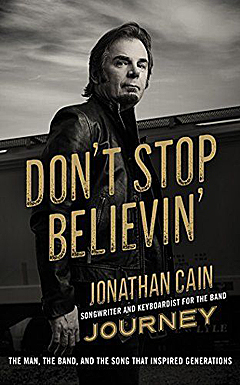
(photo credit: Michael Cairns)
Jonathan Cain: I was on a bus ride with Ross Valory (bass player of Journey) and I would tell him stories about my old days growing up in Chicago and all the crazy stuff I went through, and he said, “You’ve gotta write a book. Your story’s a good story.” So I guess I took it from there, and I started working on it. I picked up a book by Stephen King called On Writing, and when I finished that I was off and running, because he said everybody has a book in them. But I had no idea how difficult it was to write a memoir. So I just got it all down…I started collecting all the memories, and I remembered everything I wanted to put down. So that was encouraging for me.
I met this book editor, and he helped me find a home for the book; we landed a deal with (book publishers) Zondervan/Harper Collins. They’re a bigtime publisher and they were excited about my story, and they wanted to tell it the way I wanted to tell it.
Also, the Rock & Roll Hall of Fame (induction ceremony for Journey) was on the horizon (in 2017). It was a blessing, because I would be remiss if I had released the book and not had the Hall of Fame event in the book. The night of the ceremony, I really saw how the book should go. I saw Steve Perry standing next to me, and I remember him and I having this conversation (many years earlier) about writing a song for the ages. We had just met each other, and yet that’s what our dream was. At the time, the Beatles were having their resurgence (when their albums were released on CD), and we were amazed at their sales even 20 years later. And we thought…Wow, what if that happened for us one day? We were a couple guys who had just met each other, and we were marveling at the power of the songs the Beatles wrote, being together for just six years (1964-1970). It was remarkable what they did in six years. And for us, six years seemed to be the period of time that Steve and I and Neal (Schon) hunkered down together and did the big records…Escape, Frontiers and Raised on Radio…those were the big ones. It was pretty crazy that it happened in just six years.
So as I was standing onstage at the Hall of Fame, it was like the Lord showed me, “Here’s how you begin and here’s how you’ll end” (laughs). And to have the Hall of Fame event come into my life, it made me put everything in its place. I knew then the story I needed to tell, which is encouraging people to have a dream, and that anything is possible. Also, that you’re not what other people say you are…you’re uniquely you. That was my message.
DK: You’ve also released a new album called The Songs You Leave Behind. Can you talk about this album?
Cain: This was a kind of prophetic thing…I had been writing these songs about my life. After Steve (Perry) left Journey in 1987, I had to define who I was as a songwriter. Was I just the guy in Journey, or did I have something to say? And I really put myself to it. I wanted to find the guy that wrote “Faithfully,” and I did. I built a studio in my backyard, and I set about making a solo album in the ‘90s. [As it turns out] these songs fit in the audiobook perfectly, because I was defining the crossroads of my life. I wrote songs about the school fire [I survived as a child], almost drowning in a lake, my children being born, my father passing, and even my dog that I loved so much. So all these songs fit in the audiobook perfectly.
The album (The Songs You Leave Behind) is a collection of 19 songs for the people that love the story of my book Don’t Stop Believin’ that want the whole song. This is because a lot of the songs in the audiobook are only a minute or minute-in-a-half long, and then they fade away. So if you want to hear the whole songs, this album is sort of the partner to the book.
Here’s a video of Journey (with Steve Perry) performing their hit,
“Don’t Stop Believin’.”
DK: You’ve written many songs for Journey with Steve Perry and Neal Schon. What was the songwriting process for the three of you?
Cain: There was a certain preparation. We knew we were going to get together on any given day. We’d come in with something—Steve would have something in his head, I’d have something in mind, and Neal would have something in mind. We all came to the table with something to contribute, and beautifully enough, it worked well. We were on the same wavelength many times. Steve would bring in a melody and I would have the piano part for it. Or one of us would have the chorus, and I would have the lyric and he would have the melody for that lyric.
I remember how we wrote “Who’s Crying Now.” Steve was just humming this thing and snapping his fingers to this groovy thing. Steve sang what sounded like “Wooh ooh, wow ooh wow” and I’m like, “Well it sounds like you’re saying Who’s Crying Now.” And this was me just pulling stuff out of the air and pinning the tail on the donkey and there it is…Boom. Many times, Steve would scat stuff and it would sound like something. And I would ask myself…what did it sound like? Knowing we would get together, we would always try to bring a nugget to the table. We trusted each other enough in that brotherhood, to see the ideas through.
DK: In recent years, “Don’t Stop Believin’” has become Journey’s most popular song. How did you, Steve and Neal write this song?
Cain: In a nutshell, I was in Hollywood trying to make it in the ‘70s, [and at the time money was tight and] I had to ask my father for money. My dog got hit by a car, and it was a $1000 vet bill to keep her alive. I worked out a deal with the vet, and then I called my dad and said, “Gosh, I don’t have this money.” I was living month-to-month. So he loaned me some money and I said to him, “You know, I’m gettin’ my butt kicked here…should I come home?” And he said, “Jon, don’t stop believing. We had this vision for you all along since you were a little kid. You’re gonna make it, don’t worry.” And I said, “Okay dad.” So I wrote the words “don’t stop believin’” in my lyric book and kept it with me.
Then years later when I working with Journey on an album, Steve Perry asked if I had any lyrics or melodies that might work for the new album. I went home and paged through all my spiral notebooks. On the last page of my notebook I found three words scribbled: “Don’t stop believin’.” And I thought that could be a good song, and Steve would like the title and love singing that. So I wrote the chorus that night and brought it to rehearsal, and they loved it. Then the three of us kind of wrote the song backwards. Neal came up with the bass line and the B section. We didn’t really know what the lyric was going to be until the next day.
Here’s a video of Journey (with Steve Perry) performing their hit,
“Open Arms.”
I had the title and most of the lyrics for the chorus, but we didn’t know how we were gonna get there. So we went backwards (working on the verse after writing the chorus first). I shared with them how I grew up and lived in Laurel Canyon in the ‘70s, going down to Sunset Boulevard on a Friday night and seeing the menagerie of hustlers and dreamers and stuff. And I asked, “What if it was like this? This small town girl and this city boy, and they were gonna jump on a midnight train going anywhere.” [We came up with train] because Neal had this staccato guitar line that sounded like a train going somewhere. So it was like dreaming about making it. [We came up with the lyrics] “Some will win and some will lose,” and “the smell of wine and cheap perfume” might as well be the Whisky a Go Go club. And Steve and I were both singers in a smoky room, because we grew up in the nightclubs. So it was sort of a perfect concept for Steve too, so the two of us grafted that lyric and the rest is history. We laid the track down and it was the first song on the Escape album.
DK: Another one of your big hits was the ballad, “Open Arms.” How did you and Steve write this song?
Cain: I actually had that song when I came up to San Francisco. I had written the melody and the chorus, and I had lyrics to the chorus but I didn’t have lyrics to the verse. When I landed in San Francisco, Steve wanted to know if I had any ballads. He said, “I really want to sing a ballad on this album, and I’m thinking about making a solo album.” I looked at him and said, “You don’t need to make a solo album. You’ve got Journey, man. You can do anything you want in this band.” And he said, “No, I’m just looking for a ballad I can soar on.” I said, “Well I have a song called ‘Open Arms’.” So I played him the song on a little Wurlitzer piano I’d brought over to his house. Steve loved it and said, “Let’s finish the lyric.” And so we did—in about two hours, the lyrics were done.
This is one of the first songs that I knew we were a team, because it was so magically easy. Steve and I were on the same wavelength in a lot of ways lyrically. And Neal and I were very close musically. So when I would get Neal’s music, I could give it to Steve and give him some ideas. “Open Arms” was a song that Neal wasn’t part of [the writing], so we brought it in rehearsal, and the band looked at us puzzled, like “What do we do with this?” (because it was a piano ballad). And Steve was so positive—he said, “This is gonna be orchestrated and we’re gonna make it this epic ballad. It’s gonna be soaring…it will be amazing in the arenas.” The song ended up doing very well for us. It’s still the [romantic song] that couples hold on to each other and hug and kiss when they hear it.
DK: A Journey hit that you wrote by yourself was “Faithfully.” What inspired you to write this song?
Here’s a video of Journey (with Arnell Pineda) performing their hit,
“Faithfully.”
Cain: I was feeling distance with my (first) wife. I was the new guy in the band, and one day I was sitting out at an empty arena; we were waiting for our crew. I sat and watched the riggers take down the big stage and I was thinking, “Wow this is crazy, we’re like a circus family.” And I thought about how we all missed our family and loved ones…we all pay a price for the road life. Then I thought…what if we had a song that we could all hold on to each other and say “This is what we do,” and they could send that song home and Journey says, “We’re forever yours…Faithfully.” And so I started writing this song on a bus. I wrote the lyrics on a napkin.
I went to sleep and I woke up the next morning, and I took the napkin with me. I looked at it and I started writing. I wrote the lyrics, line after line. It was pouring out of me. And then I had a little Casio keyboard and I started plunking out the melody. Then I took the song to soundcheck, and I found this big symphony piano and started playing the song. I realized that it was a good song and that I would show it to Steve. I knew he would love it.
So I played Steve “Faithfully,” but then he said he wanted it for his solo album. And I took the cassette from him and said, “No…it has to be for Journey.” And he said, “Really?” I said, “You write your own album. This is a Journey song.”
Then later on for the Frontiers album (in 1983), the producer called me and said, “We’re gonna cut a ballad. Bring in a ballad tomorrow. I was wondering…how did he know this? I had only played “Faithfully” for Steve. But it was the producer who brought this song into light. Then we recorded it—Neal wrote a chart, Ross wrote a chart…we did three takes. Then Steve said, “I’ll sing it on one condition. You stay away from the studio and let me do my thing with it.” I said, “You got it, sir.” So I think he sang it for a couple of days, and they comped the vocals and called me in and I got chills when I heard it. And that’s how the song came to be. Sreve did an amazing job. And Neal played an amazing guitar solo on it, and he came up with the french horn part.
Some songs you write just get bigger than anything you’d imagine. When we played it live, we started seeing fans coming into the show with signs saying, “We’re forever yours…Faithfully.” And I said, “Alright…that’s it—they can’t kick me out of the band now (laughs).
DK: You’ve been with Journey for almost 40 years now. How would you sum up the experience of being with this band for all these years?
Cain: Yeah it’s been 37 years. You know, I guess we became the soundtrack for people’s lives. It’s remarkable to be part of that musical legacy, and then to go into the Rock & Roll Hall of Fame really caps it off. You realize that this music resonates with people, and it’s important to keep it alive. It’s just remarkable and an honor, and you live in that grateful place all the time and just go, “Thank you.” And I give the Lord all credit and praise for my success throughout these years. As I mentioned in the book, it had to be divine intervention to send a kid from Chicago into the Journey camp (laughs). We would write this music, and I had no idea what I was walking into, except the Lord did. He said, “It’s gonna be great, Jon.” (laughs).
Here’s the link to Jonathan Cain’s site: https://www.jonathancain.org/